 4.6 / 5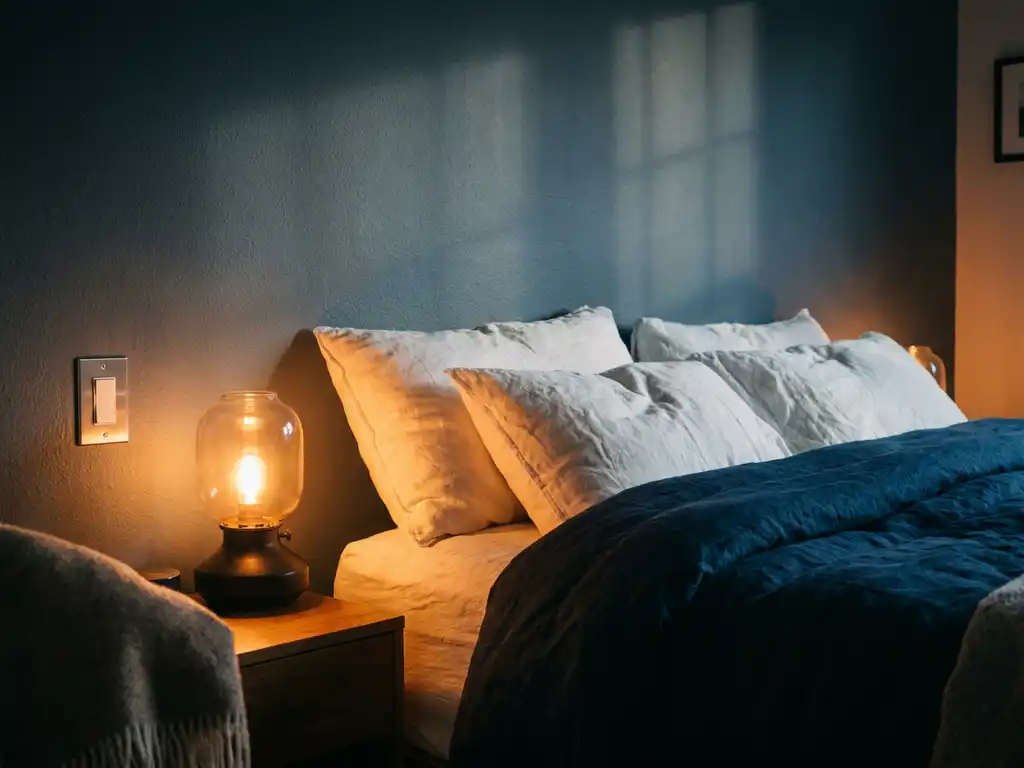
Dimming the lights in the evening is good for your sleep because bright light suppresses the production of melatonin, the hormone that tells your body it’s time to sleep. By gradually lowering the light intensity in the hours before bedtime, you signal to your brain that the day is over. In this article, we answer the most frequently asked questions about dimming and sleep.
How does light intensity affect melatonin production?
The brighter the light in the evening, the less melatonin your body produces. Melatonin is the hormone that regulates your sleep-wake cycle. Your brain produces it as soon as it gets dark, but high-intensity artificial light disrupts this process and keeps your body in a state of alertness.
The light-sensitive cells in your eyes send signals to the brain that directly influence your biological clock. Bright light signals that “it’s still daytime,” which delays melatonin production. If you gradually dim the lights, your body understands that evening is approaching and begins producing melatonin earlier and more smoothly.
This isn't a matter of personal preference, but of biology. The quality of your sleep improves measurably when you adjust the lighting in your home to match the natural rhythm of the day.
Regel het licht precies zoals u wilt
Ontdek onze led-dimmers en controls: draaiknop, drukknop of aanraakvrij — altijd upgradebaar.
Bekijk led-dimmersWhat color temperature is best for evening lighting?
For evening lighting, a warm color temperature is best, preferably between 2200 and 2700 Kelvin. This is the warm yellow light you’re familiar with from traditional incandescent bulbs. Cool white light, such as fluorescent tubes or daylight bulbs above 4000 Kelvin, contains a lot of blue light, which significantly suppresses melatonin production.
Blue light has an effect similar to that of daylight and activates the same mechanisms in your brain that keep you awake. The later it gets in the evening, the more you should avoid exposure to it. Warm white light has virtually no such effect and aligns with the natural transition from day to night.
For the bedroom, living room, and bathroom, it’s best to choose lights with a warm color temperature. Combined with dimming, this creates the perfect evening atmosphere to help your body wind down for a good night’s sleep.
What time should you start dimming the lights to get a good night's sleep?
Start dimming the lights at least one to two hours before you go to bed. For most people, this means starting to lower the light intensity around 9:00 or 10:00 p.m. The more gradual the transition, the more time your body has to produce melatonin.
A useful rule of thumb is to break the dimming process down into three steps:
- Two hours before bedtime: Reduce the light intensity to about 50 percent of the maximum.
- One hour before bedtime: Dim the lights to 20 to 30 percent, and preferably use only floor lamps or mood lighting.
- Just before bedtime: Turn off all bright lights and use no more than one mood lamp set to the lowest setting.
This rhythm helps your body clock wind down at the right time, without making an abrupt transition from bright light to total darkness.
What is the difference between using a dimmer switch and simply turning off the light?
The difference between dimming the lights and turning them off lies in the transition. Turning off the lights is abrupt and doesn’t give your body time to adjust to the change. A dimmer allows you to gradually reduce the light intensity, which aligns much better with the natural rhythm of sunset.
What’s more, for many people, it’s neither pleasant nor practical to suddenly find themselves in the dark in the evening. You still want to be able to read, have a conversation, or just relax. With a dimmer, you can control the ambiance and brightness without having to choose between “on” or “off.”
Another benefit is energy savings. Dimmer lighting uses less electricity than lighting at full brightness. That’s an added benefit on top of the sleep benefits: you sleep better, and your energy bill gets a boost too.
Which rooms in the house benefit most from a dimmer switch?
The rooms where you spend the most time in the evening benefit the most from a dimmer switch. In most homes, these are the living room, the bedroom, and the bathroom. In each of these spaces, light intensity plays a different—but important—role in your evening routine.
- Living room: This is where you unwind after a day at work. Dimmable lighting helps you consciously switch from active mode to relaxation mode.
- Bedroom: Bright light in the bedroom right before bedtime is one of the most common causes of poor sleep. A dimmer switch gives you the control you need to avoid this.
- Bathroom: The bathroom is often the last place you visit before going to bed. Bright fluorescent lights or spotlights can disrupt melatonin production at the last minute. A dimmed light or a separate mood setting can make a big difference here.
A hallway or corridor with dimmable lighting can also be helpful, especially if you get up at night and don’t want to be suddenly blinded by bright light.
Can a smart dimmer control the dimming automatically for you?
Yes, a smart dimmer can fully automate the dimming process based on a schedule or sunset. You simply set the time when the lights start to dim and how much they should dim, and the dimmer takes care of the rest every night. That way, you don’t have to think about it anymore.
Smart dimmers with Zigbee, Wi-Fi, or Bluetooth can be connected to platforms such as Philips Hue, Homey, or KlikAanKlikUit. This allows you to set up dimming schedules via an app or have the dimmer work together with other smart devices in your home. Some systems even automatically adjust the lighting based on the season and local sunset times.
The main advantage is consistency: your evening routine is supported without you having to think about it. That is precisely the power of smart lighting automation.
Schakelen zoals het u uitkomt
Bekijk onze led-lichtschakelaars: eenvoudig te installeren en klaar voor de toekomst.
Bekijk lichtschakelaarsHow Freelux Helps You Dim the Lights for a Better Night's Sleep
At Freelux, we understand that for many people, the transition to smart lighting should be a simple one. No complicated installations, no demolition work—just a smart solution that works right away. Our dimmers are designed with exactly that in mind: simple, effective, and suitable for existing homes.
What we offer to help you create a better sleeping environment:
- Digital LED dimmers that dim smoothly without flickering, suitable for most LED bulbs
- Smart versions with Zigbee, Wi-Fi, or Bluetooth, compatible with Homey, Philips Hue, and KlikAanKlikUit
- Schedules can be set via the app, so that the dimming process runs automatically every evening
- Stylish finishes that complement any interior and fit into standard System 55 recessed frames
- Easy installation with no programming knowledge required
Whether you're looking for a simple LED dimmer for your living room or bedroom, or a smart solution to help you with your entire evening routine, you'll find the right product for your needs in our online store. Browse our selection and take the first step toward better nights today.
Frequently Asked Questions
Will dimming work even if I've been having trouble sleeping for a long time?
Dimming the lights can certainly help you sleep better, even if you’ve been experiencing sleep problems for a long time. Adjusting your lighting environment is one of the most effective, non-medicinal ways to reset your body clock. Combine dimming the lights with other sleep hygiene practices, such as avoiding screen time right before bed and sticking to a regular sleep schedule, for the best results. If sleep problems persist, it is always wise to consult a doctor as well.
Does dimming help even if I'm still using my phone or laptop in the evening?
Dimming certainly helps, but the effect is partially negated if you’re still looking at a bright screen at the same time. Smartphones, tablets, and laptops emit a lot of blue light, which can suppress melatonin production just as much as bright overhead lighting. So be sure to enable night mode or a blue light filter on your devices, and try to limit screen use as much as possible in the hour before bedtime. Dimming and screen hygiene reinforce each other.
Aren't all LED bulbs compatible with dimmers?
Niet elke LED-lamp is dimbaarbaar — dit staat altijd vermeld op de verpakking of in de productspecificaties. Gebruik je een niet-dimmbare LED-lamp met een dimmer, dan kan dit leiden tot flikkering, zoemen of vroegtijdige slijtage van de lamp. Kies altijd voor LED-lampen die expliciet als ‘dimmbaar’ zijn aangemerkt, en combineer ze met een dimmer die geschikt is voor het vermogensbereik van jouw lampen voor een soepel en storingsvrij resultaat.
What if I rent my home and can't install a dimmer switch?
Ook in een huurwoning zijn er goede oplossingen om ‘s avonds met gedimde verlichting te werken. Denk aan snoerdimmers die je tussen het stopcontact en de lamp plaatst, of aan slimme lampen met ingebouwde dimmerfunctie die je via een app bedient zonder dat je iets aan de bestaande schakelaar hoeft te veranderen. Losse staande lampen of tafellampjes met een warmwitte LED-lamp en een ingebouwde dimmerfunctie zijn eveneens een laagdrempelig alternatief. Zo profiteer je van alle voordelen zonder verbouwing.
How do I know what dimming capacity I need for my lights?
The required dimming capacity depends on the total wattage of the LED bulbs you connect to a single dimmer. Add up the wattage of all the bulbs in the group and choose a dimmer with a maximum capacity that is well above that total—keep in mind the minimum load requirement for LEDs, as many dimmers only work properly starting at a certain minimum wattage. Not sure? Check the dimmer’s product specifications or contact the supplier for personalized advice.
Can I easily replace an existing switch with a dimmer switch?
In many cases, replacing a standard light switch with a dimmer is a simple job you can do yourself, provided you turn off the power at the circuit breaker panel first. Modern dimmers are designed to fit into standard wall boxes and come with clear installation instructions. Keep in mind, however, that some dimmers require a neutral wire, while others work without one. If in doubt, always consult a licensed electrician.
Does it matter if I dim one light or the whole room?
The more light sources you dim, the greater the effect on your melatonin production and sleep quality. A single dimmed light in an otherwise brightly lit room has limited effect, because your eyes are still exposed to the total light intensity in the room. Therefore, try to dim or turn off all active light sources in a room, and switch to one or two mood lights on a low setting as the evening progresses. This way, you create a consistent, sleep-friendly lighting environment.