 4.6 / 5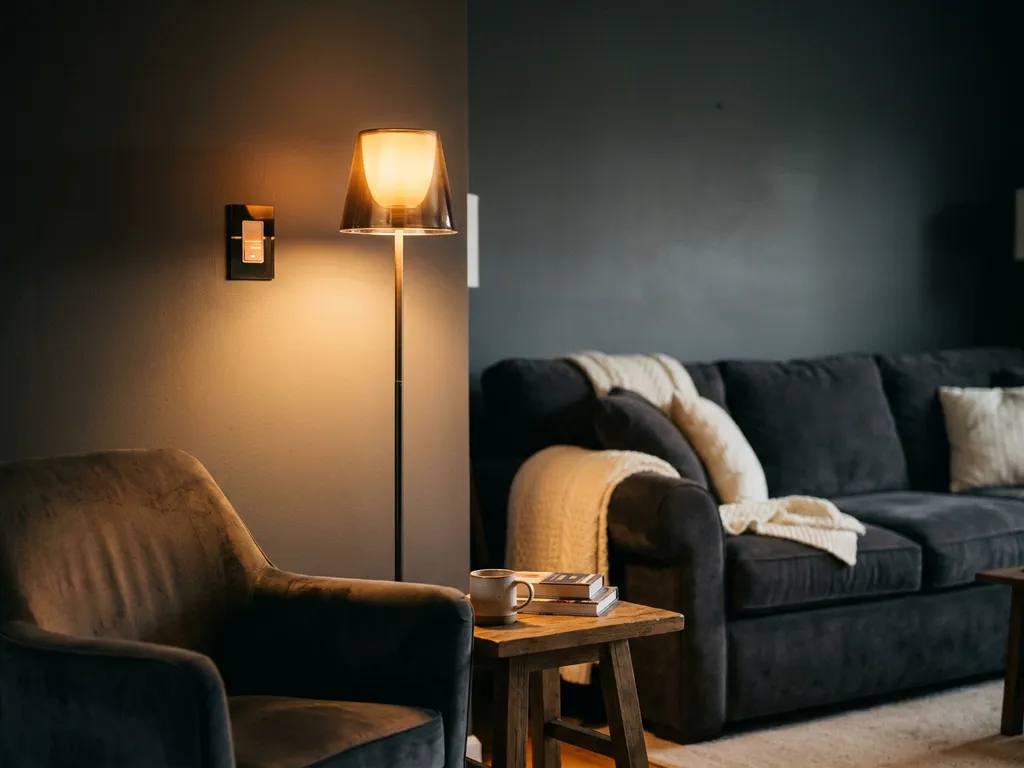
For ambient lighting, a light output of between 100 and 400 lumens per light source is ideal. This is intentionally low: ambient lighting is meant to create a warm, relaxing atmosphere, not to fully illuminate a room. The exact amount depends on the size of the room, the number of light sources, and your personal preference. In this article, we answer the most frequently asked questions about ambient lighting, from lumens and color temperature to dimming and installation.
How many lumens do you need for ambient lighting?
For ambient lighting, you generally need 100 to 400 lumens per light source. By comparison, a standard reading lamp produces 800 to 1,000 lumens. Ambient lighting is intentionally softer and more indirect, so the room feels inviting without straining your eyes.
The total number of lumens you need depends on the size of the room and the number of light sources you use. A 25-square-meter living room doesn’t need 5,000 lumens for ambient lighting, as it would for task lighting, but rather scattered light sources of 150 to 300 lumens each. Think of floor lamps, wall sconces, or light strips behind a TV or along the ceiling.
A good rule of thumb: use several small light sources instead of a single powerful lamp. This creates more depth, fewer shadows, and a much warmer atmosphere.
Regel het licht precies zoals u wilt
Ontdek onze led-dimmers en controls: draaiknop, drukknop of aanraakvrij — altijd upgradebaar.
Bekijk led-dimmersWhat color temperature is best suited for ambient lighting?
The ideal color temperature for ambient lighting is between 2200 and 2700 Kelvin. This is the warm white range, similar to the light from a candle or a traditional incandescent light bulb. The lower the Kelvin number, the warmer and cozier the light appears.
Cool white light (4000 Kelvin or higher) is great for a kitchen or office, but it’s counterproductive for mood lighting. It feels bright and businesslike, which is exactly the opposite of what you want to achieve on a quiet evening.
Want more flexibility? Then choose a light or lighting system that lets you adjust the color temperature. That way, you can work in bright light during the day and easily switch to a warm, cozy atmosphere in the evening—without having to change the bulb.
What is the difference between lux and lumens when it comes to ambient lighting?
Lumen indicates how much light a lamp emits. Lux indicates how much of that light falls on a given surface. This difference is important when it comes to ambient lighting, because the same lamp provides many more lux in a small room than in a large open space.
For mood lighting in a living room or bedroom, a general guideline is a light level of 50 to 150 lux. That is significantly less than the 300 to 500 lux you need for reading or working. When choosing lamps for mood lighting, it’s best to check the lumen rating on the packaging and take into account the distance to the surface you want to illuminate.
In summary: lumens describe the light source itself, while lux describe the effect in your space. Both are useful, but when it comes to mood lighting, the experience is ultimately more important than the measurement.
How do you dim your lights to create the perfect ambiance?
You can achieve the perfect ambiance by dimming your lights to 20 to 40 percent of their maximum brightness. At that level, the light feels warm and relaxing without making the room feel dark or uncomfortable. A good dimmer makes this easy to adjust.
When dimming, please note the following:
- Not all LED bulbs are dimmable. Check the packaging for the dimmable LED symbol.
- Use a dimmer that is specifically designed for LED lighting. An old dimmer intended for incandescent bulbs can cause flickering.
- It is best to dim multiple light sources at the same time to create an even atmosphere in the room.
- A wireless dimmer gives you the freedom to adjust the brightness without getting up.
An LED dimmer makes all the difference between a light that’s simply on or off and a truly atmospheric evening. Modern dimmers are easy to install and work with most standard LED bulbs.
Which lights are best suited for ambient lighting?
The best bulbs for ambient lighting are dimmable LED bulbs with a warm white color temperature of 2200 to 2700 Kelvin. They are energy-efficient, have a long lifespan, and provide the warm light that ambient lighting requires.
Popular choices for mood lighting include:
- Filament LED bulbs with visible filaments: they emit a nostalgic, warm light and have a decorative appearance.
- LED strips: ideal for indirect lighting behind furniture, along ceilings, or under kitchen cabinets.
- GU10 spotlights with warm white light: ideal for focused accent lighting on a work of art or a niche.
- LED candle bulb: a small bulb shaped like a flame, perfect for wall sconces and chandeliers.
- Smart lights with adjustable color temperature: offer maximum flexibility for different moods.
Always choose dimmable bulbs if you plan to use a dimmer switch. Non-dimmable bulbs may be damaged or start to flicker when connected to a dimmer switch.
Can you create mood lighting without major renovations?
Yes, you can easily create mood lighting without any chiseling, drilling, or rewiring. Wireless dimmers, smart switches, and battery-powered wall controls make it possible to fully customize your lighting in an existing home.
Modern wireless lighting solutions use Zigbee, Bluetooth, or Wi-Fi and are compatible with popular platforms such as Philips Hue, Homey, and KlikAanKlikUit. You simply install a smart dimmer or switch over your existing wall box and control the lighting via an app or wall-mounted control. No electrician needed, no damaged walls.
There are solutions available even for older homes with outdated wiring. Some wireless dimmers even work without a neutral wire, making them suitable for situations where the wiring is incomplete.
Schakelen zoals het u uitkomt
Bekijk onze led-lichtschakelaars: eenvoudig te installeren en klaar voor de toekomst.
Bekijk lichtschakelaarsHow Freelux Helps Create Ambient Lighting
At Freelux, we understand that you want to create mood lighting without the hassle. That’s why we develop smart lighting solutions that are easy to install and deliver immediate results, even in existing homes. Our product range is specially curated for people who want to upgrade their homes without major renovations.
What we offer for the perfect ambient lighting:
- Digital LED dimmers for smooth, flicker-free dimming from 1 to 100 percent
- Wireless wall-mounted controls that you can place anywhere in the room without any wiring
- Smart dimmers with Zigbee, Bluetooth, or Wi-Fi, compatible with Philips Hue, Homey, and KlikAanKlikUit
- Products that fit into standard System 55 flush-mount frames, so your existing switchgear remains reusable
- A no-nonsense approach: smart and user-friendly, without complicated programming
Ready to add the perfect ambient lighting to your home? Browse our full selection of LED dimmers and lighting controls in our online store, or contact us for personalized advice.
Frequently Asked Questions
Can I replace standard LED bulbs with dimmable ones without changing the socket?
In most cases, yes. Dimmable LED bulbs are available in the same base types as standard LED bulbs, such as E27, E14, and GU10. You just need to check that the base in your light fixture matches the dimmable bulb you want to use. Be sure to also install a compatible LED dimmer at the same time; otherwise, you won’t be able to take advantage of the dimming feature and you risk flickering or premature bulb wear.
What should I do if my LED light keeps flickering when I dim it?
Flickering when dimming is almost always caused by an incompatible dimmer, often an old dimmer that was originally designed for incandescent bulbs. The solution is to use a dimmer specifically designed for LED lighting. Also, check whether the bulb itself is dimmable; if there is no dimmer symbol on the packaging, the bulb is likely not suitable. Sometimes it also helps to adjust the dimmer’s minimum setting, which is possible on many modern LED dimmers via a small adjustment screw.
How many light sources do I need to create a cozy living room?
A good rule of thumb is to use three to five light sources spaced out throughout an average living room of 20 to 30 square meters. Consider a combination of a floor lamp, one or two wall sconces, and perhaps an LED strip for indirect ambient lighting. By placing light sources at different heights and locations throughout the room, you create depth and a layered atmosphere that feels much warmer than a single central ceiling light.
Is mood lighting suitable as the only source of light in a room, or do I always need additional lighting?
Ambient lighting is specifically designed as supplementary lighting and is not sufficient on its own for activities such as reading, cooking, or working. For those tasks, you need functional lighting of 300 to 500 lux. The ideal lighting plan combines both: bright task or ceiling lighting for when you’re actively engaged, and dimmable ambient lighting for the evening or moments of relaxation. With a good dimmer, you can easily switch between the two modes.
Do smart dimmers work even if I don't have a smart home system?
Yes, most smart dimmers also work as standalone devices without requiring a full smart home system. In many cases, you can simply control them using a dedicated app on your smartphone or the included wireless wall switch. If you want to connect them to a platform like Philips Hue or Homey later on, most Zigbee or Wi-Fi dimmers can be easily added. So you can start small and expand when you’re ready.
How does the energy consumption of ambient lighting compare to that of regular lighting?
Mood lighting generally uses significantly less energy than functional lighting, for two reasons: you use lower-wattage bulbs, and you dim them to 20 to 40 percent of their maximum output. A 6-watt dimmable LED bulb dimmed to 30 percent actually uses less than 2 watts. If you use multiple such light sources at the same time, the total energy consumption is still lower than that of a single traditional 50-watt halogen bulb.
How do I choose the right dimmer if I have multiple lights in a single circuit?
If you have multiple lights on a single circuit, it is important to add up the total wattage of all the lights and choose a dimmer with a maximum load capacity that exceeds that total. LED lighting also has a minimum load requirement; some dimmers do not function properly if the total wattage is too low, for example, if you connect only one small light. Check the dimmer’s specifications for both the minimum and maximum power ratings for LED, and if in doubt, choose a dimmer with a slightly higher capacity than you currently need.
Related articles
- Hoe weet je of je een led lamp kunt dimmen?
- Hoe lang gaat een LED dimmer mee?
- Hoe kan ik mijn lamp slim maken met Zigbee?
- Kan ik meerdere lampen op één dimmer aansluiten?
- Why is my dimmer buzzing?
Deze inhoud is gegenereerd met behulp van AI en kan fouten bevatten.